I spent years taking the rain on the streets of Berlin. I discovered museums with visitors from Taiwan and Finland. I taught (and learned) sociology with design students, studied philosophy with philosophers, lectured writing to public servants. I scoured bookstores. I immersed myself in libraries. I saw my reading capacity damaged by digital forces. I worked and I got tired. I wrote and I read. I reread The Human Condition: to think about what we are doing.
With these pieces of experience in my travel bag, I propose the following lines to think about what we are doing with education. Here is my wandering deduced into methods (paths) of thought:
Itinerant. Thinking is to leave one’s place. I do not speak metaphorically, but literally. I think of a thinking that moves head and legs. Instead of seated education (in the classroom or on the screen), I propose returning to the peripatetic: thought expeditions to open physical eyes and mental eyes.
Physical. We think with the head, ear, nose, hand, circumstances of the body. One thinks by reading, writing, speaking, silencing. One thinks with and without words. Thinking is multisensory. Body and mind are not split, but united in the totality of existence.
Human. A Large Language Model (LLM) accumulates data, analyzes, synthesizes, and joins, probabilistically, words into sentences into paragraphs into texts. But LLMs cannot gather in the square. They cannot travel to a mass grave. They cannot incarnate a speech about pain, about life, death, justice, about “alienated” labor – for they do not suffer, they do not tire, they do not need sleep. A human space of education is literal too: the presence of other bodies and faces that limit us and expand us.
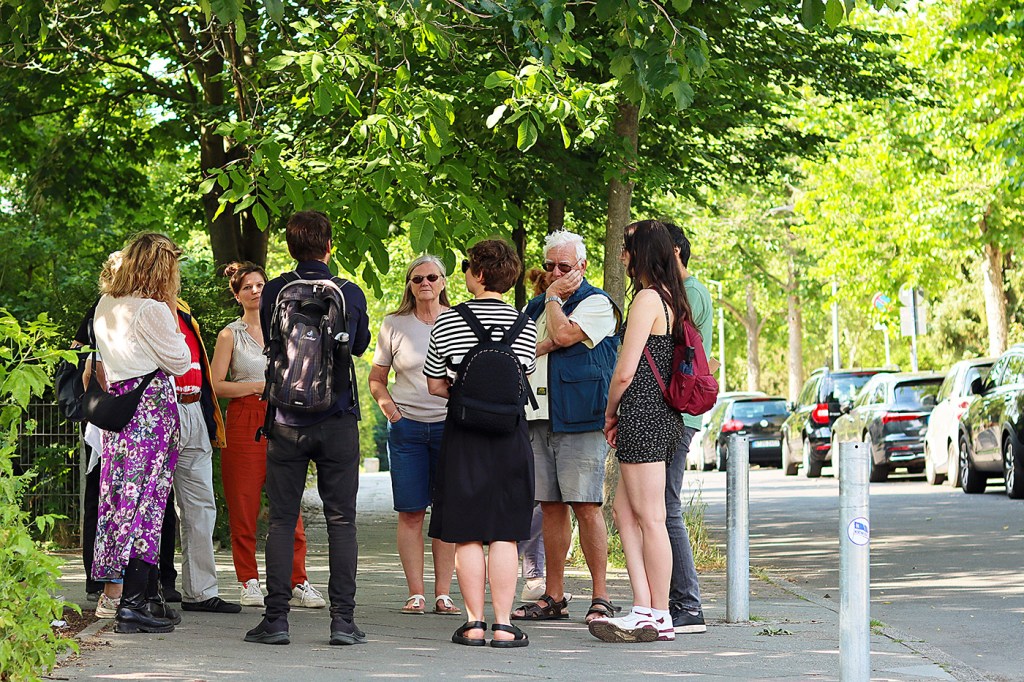
An Itinerant Method in Mariendorf, Berlin (Photo: Radi Dhan)
Education as it exists – between, on one side, a fragmented academy, also tired and in crisis, and, on the other, an uncritical techno-messianism – may not account for the many impasses of our time (I develop this crisis further here). Therefore, I propose a practice that is, besides itinerant, eccentric.
An Eccentric Practice. A “School” Without a Center.
I propose a reflective move to the physical world, to what Walter Benjamin might have called the aura of places where people gather to deliberate – educating themselves among examples, pieces of the past, open answers. It can also mean a sensory expansion of what Fred Dewey initiated with the Portable Polis. And it can be responses to situations, designing programs of thought based on perplexities.
Here are some ideas:
We can study How Not to Be the Crazy Uncle exploring lessons from Arendt’s The Origins of Totalitarianism, reading the text at memorials and political sites; we can travel between Germany, Poland, and Italy with the theme Remembering to Remember, elaborating on questions of collective memory, amnesias and amnesties; we can create sessions-deliberations on Has Truth Truly Ended?, in documentation centers, journalism newsrooms, social media agencies, departments of historiography; we can create a program-question on Is There a Remedy for the World’s Pains?, crossing psychology, psychiatry, and politics, thinking about interactions between self and society; we can read and deliberate in theaters and cinemas on whether we have become Subjects to Shocks, an update of the concept of subjection, no longer to kings, but to dopamine and behaviorist tactics.
We can work with schools and universities. We can organize with professional groups (architects, journalists, lawyers, psychologists, programmers, etc.), overcoming technical fragmentation with philosophical and humanist visions. We can gather informal groups, laypeople, and transnational citizens who want to think about what we are doing, visiting sites, encountering other faces and voices.
The paths are many, and they are open. The horizons for thinking together are unlimited. The task is urgent. If you have ideas to update the itinerant method, write to me at rafaelkasper@gmail.com
 Rafael Kasper